Reducing
Time-to-Market
Identified systemic bottlenecks across 2 cross-functional teams, redesigned the end-to-end launch workflow, and increased productivity through faster photography cycles — reducing set up time by 8 hours per week.
40% Launch Cycle Reduction
60% Launch Cycle Reduction
3x Output At Same Cost
5 Teams Aligned
01 - PROBLEM
The system was breaking — quietly, repeatedly, at scale.
Every product launch cycle, we experienced the same failure modes: late creative assets, unclear approval ownership, last-minute changes that cascaded into delays, and a team that was working harder than ever but launching slower than the business needed.
The surface symptom was missed deadlines. The real problem was structural — no single owner of the process, no standardized handoffs, and no shared visibility into where work stood at any given moment.
The business had scaled its product volume without scaling its production infrastructure. What worked for 50 SKUs per season was collapsing under 200+.
Products were launching 2–3 weeks late on average, compressing sell-through windows and eroding full-price revenue potential by an estimated 12–15% per cycle.
02 - INSIGHT
The bottleneck wasn't effort. It was handoffs.
I spent two weeks mapping the existing workflow end-to-end — interviewing each team, logging where work was handed off, and tracking where it stalled. The data was clear.
The process had five distinct handoff points between teams
(merchandising → creative → photography → copy → approvals).
At each one, there was no documented SLA, no single owner, and no system of record.

Key finding:
72% of all delays occurred at just two handoff points. The rest of the process was functional. This meant I didn't need to rebuild everything — I needed to surgically fix two broken interfaces.
03 - STRATEGY
Strategic principle: the team wasn't failing — the system was. Any solution had to eliminate ambiguity at handoff points, create shared visibility, and assign clear ownership — without adding bureaucracy.
I ran a 4-week pilot with one product line before full rollout — allowing me to stress-test SLAs, refine the dashboard, and socialize the new approval protocol without disrupting the business.
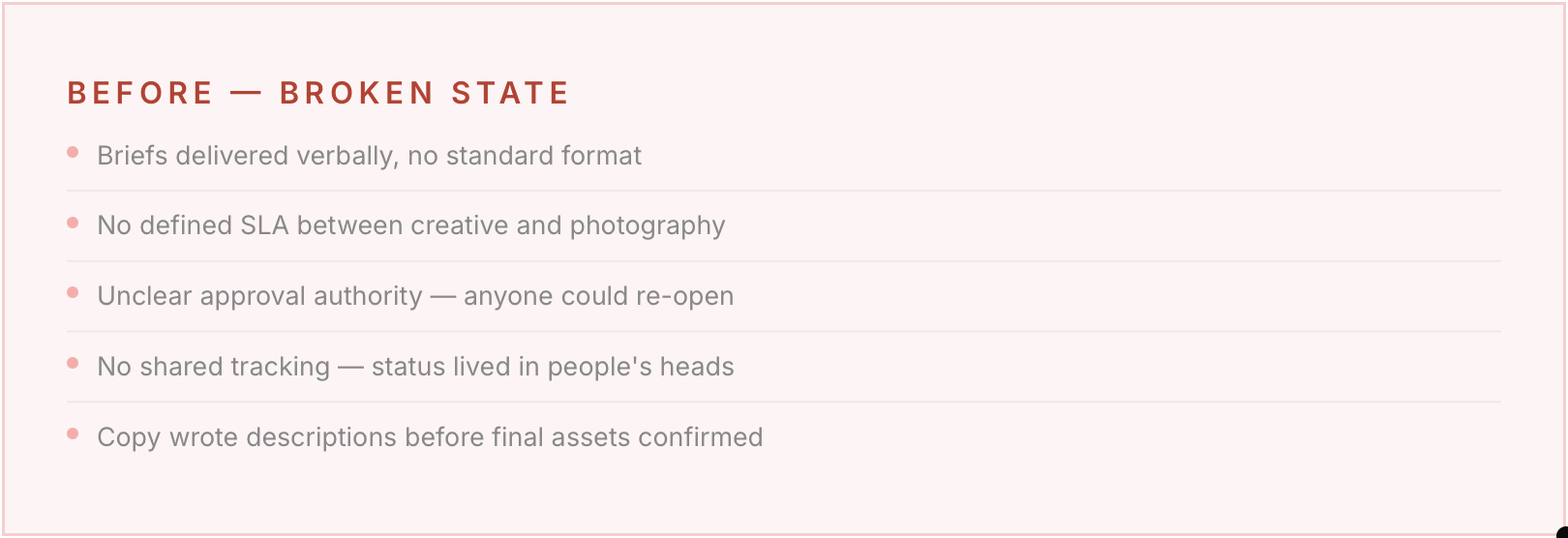
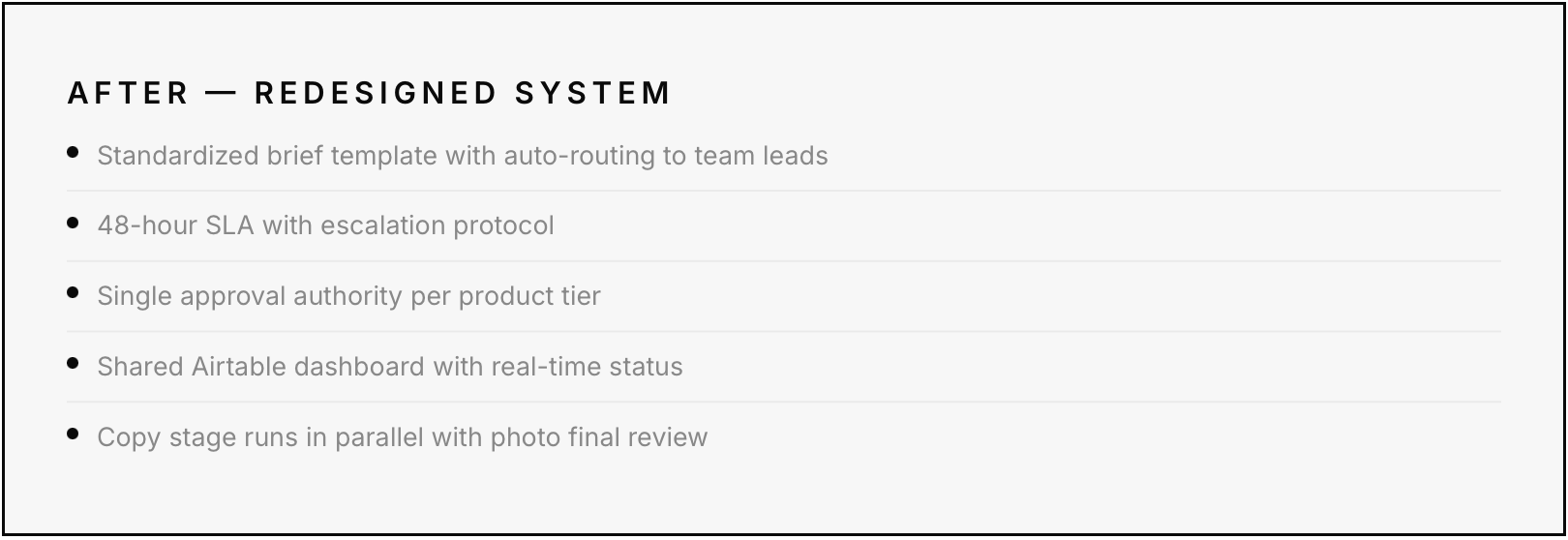
04 - EXECUTION
I addressed this with three tactics:
Transparency over control. A shared dashboard and andon system everyone could see. Delay was now visible to all, with a clear owner at every stage. The "it's not my fault" dynamic disappeared.
Win the influencers first. I identified the two team leads with the most informal authority and brought them into the design phase early. Their buy-in made adoption organic.
Data-driven retrospectives. After each cycle I ran a 30-minute retro with the velocity data. Showing teams their own improvement made momentum self-sustaining.
I owned the redesign end-to-end. The key challenge wasn't system design — it was behavioral change. Teams had worked the old way for years.

05 - OUTCOMES
The numbers told the story clearly.
After a full-season rollout, the results were measurable across every metric that mattered:
40%
Reduction in average launch cycle time
18D - 7D
Average Delay
Eliminated
40%
Reduction in average launch cycle time
100%
Team Adoption in
6 Weeks
3x
Output At Same Headcount
60%
Fewer Revision Loops
Beyond the metrics: the team's morale improved significantly. People stopped firefighting and started planning. The process became a competitive advantage, not a constraint.